

Indeed, Has Paul Really Said?
A Review of N.T. Wright's Book, What Saint Paul Really Said
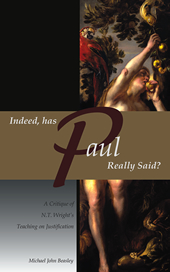
It was Martin Luther who said that the doctrine of justification by faith is “the doctrine by which the church stands or falls.” As an acknowledgement of this reality Indeed, has Paul Really Said? is set forth as a modern-day defense of the crucial doctrine of justification, in response to those who seek to undermine such a doctrine by means of the theological innovations of men like N. T. Wright. In particular, Indeed, has Paul Really Said? is a critique of Wright’s own work: What Saint Paul Really Said (Eerdmans Publishing, 1997), and endeavors to simplify the presumed controversy over justification by faith. Therefore, rather than perusing every nuance of Wright’s position, this book simplifies matters by revealing the Achilles’ Heel of Wright’s teaching regarding the expression the righteousness of God, through four comprehensible and reproducible evaluations concerning:

1. A Lexical Analysis of the terms - righteousness, justification , and the expression - the righteousness of God.

2. The forensic [judicial] connotation of these terms.

3. The relevance of Paul’s background as a Pharisee.

4. The manner in which justification is revealed within the whole counsel of God’s Word.

In the final analysis, justification is not a “logic chopping” doctrine, instead it is foundational to that which distinguishes the genuine Gospel from every false imitation. God has indeed said: “...Abraham believed God, and it was reckoned to him as righteousness.” It is this truth that has marked the very essence of Gospel hope in every generation. May the Lord preserve our own generation in such a Gospel hope in the one true object of faith for all men - the Lord Jesus Christ.

Copyright Year: © 2008

 
US Distributors


UK Distributors
 
amazon

Indeed, Has Paul Really Said?
~ Index ~

~ Introduction ~
A Catastrophic Conversation

Within this introduction of Indeed, has Paul Really Said? the question is raised concerning the value and importance of addressing controversy. Not all theological conversations are profitable, and some matters should be ignored altogether. It is here that the query regarding N.T. Wright's doctrinal influence is addressed, and even the question of the tone of this work is considered. Clearly, not all controversies are worthy of confrontation; alternately, not all controversies should be ignored. In the case of N.T. Wright, his teaching on the subject of justification cannot be ignored at all. The roadmap to our discussion of justification is as follows:

1. A Lexical Analysis of the terms - righteousness, justification , and the expression - the righteousness of God.

2. The forensic [judicial] connotation of these terms.

3. The relevance of Paul’s background as a Pharisee.

4. The manner in which justification is revealed within the whole counsel of God’s Word.

No matter how complex Wright's arguments may seem, these four simple points of evaluation will prove to be indispensable to the reader.

~ Chapter 1 ~
The Righteousness of God - A Lexical Analysis

Central to Wright's argument concerning the doctrine of justification is his lexical/historical analysis of the word righteous, along with the expression the righteousness of God. It is in this chapter that Wright's arguments are laid bare and then reviewed by the standard of Scripture. Wright's attempt to retool the meaning of the term righteous/righteousness requires a great deal of historical and lexical revision. This chapter addresses his arguments and his errors. The greatest error committed by Wright is that he fails to acknowledge the concept of a lexical domain and, through this, he offers a problematically monolithic view of righteousness. The great danger of any word study is that word meanings, if stripped of their contextual and historical meaning, can reduce any text to a muddled, confusing heap.

~ Chapter 2 ~
The Righteousness of God and the Forensic Context

The question concerning the forensic connotation of the word righteousness proves to be another central aspect of Wright's argument. It is here that Wright ultimately seeks to eliminate the concept of imputation entirely, arguing:

"...it makes no sense whatever to say what the judge imputes, imparts, bequeaths, conveys or otherwise transfers his righteousness to either the plaintiff or the defendant.  Righteousness is not an object, a substance or a gas which can be passed across the courtroom..." (What Saint Paul Really Said, p. 98).

The above conclusion is, in part, formulated from Wright's deeply flawed representation of the O.T. judiciary. Wright's attempt to "unpack" the O.T. judiciary is intended to direct the reader into a new perspective on the notion of justification and imputation. This problem is presented and addressed in the following excerpt from Indeed, has Paul Really Said?:

"...as to the details of the Jewish courtroom, we must note that there are problems with Wright’s presentation of this courtroom scene, both as a historical reality and as an earthly parallel to God’s own judiciary.  This is important because his errors yield serious misconceptions concerning the contents of, and the actions taken, in God’s judiciary.  A careful examination of Scripture shows that Wright fails to "unpack" all of the components of God’s courtroom, and this renders a corruption of his notion of forensic justification.

Ultimately, these errors will help us to evaluate Wright’s argument concerning the forensic aspect of God’s righteousness.  To do this, it will be necessary for us to examine several of the O.T. and N.T. texts that relate to our subject at hand.  It will be especially needful for us to include N.T. revelation in this discussion, because without it, we are left with nothing but the tenebrous shadows of the Old Covenant, devoid of the light and substance of Christ Himself.   In fact we can’t expect to go to the O.T. Scriptures and successfully decipher the forensic justification of Christ apart from going to the very One to whom the O.T. points.  Or as Paul himself said:

Galatians 3:24 Therefore the Law has become our tutor to lead us to Christ, so that we may be justified by faith.

Thus, our examination of Christ’s forensic justification will begin with the O.T. Scriptures, but then by the Law’s pedagogy we will turn to Christ in the N.T. in order to come to a proper understanding of the full counsel of God – something that the Apostle Paul was dedicated to with his very life.  By doing this, we are in fact imitating Paul’s own wisdom as expressed in Galatians 3:24.  What better way might a person come to discover what Paul really meant and said?..."

The details of this section are essential in order to see, not only the failure of Wright's resultant logic and exegesis, but also the faulty nature of his process of analysis. Exegesis, by definition, is the process by which an interpreter's instruction is derived out (ex) of the text; rather than the interpreter offering an instruction which infuses his own thinking into (eis) the text. Chapter two sadly affirms, yet again, that Wright's commitment is to the latter process, rather than the former.

~ Chapter 3 ~
The Righteousness of God and Paul's Apostleship

One of the greatest ventures of modern scholarship is this matter of what is called Second Temple Judaism. For the reader to understand this concept better, especially as Wright employs it himself, I would suggest E.P. Sanders' book: Common Judaism, Explorations in Second-Temple Judaism. At the core of this system of thought is this assumption that the N.T. Writers were heavily influenced by the contemporary Judaism of their day, along with the intertestamental writings found within the Pseudepigrapha. From these broad assumptions, Wright then argues that the Apostle Paul was deeply influenced by Shammaite Pharisaism - this despite the fact that it contradicts Paul's own testimony regarding the background and value of his pharisaical pedigree. In this chapter, we explore Wright's arguments on this matter in contrst with Paul's own testimony about himself. In conclusion, we explore the dangers of arguing that Paul (an Apostle of Jesus Christ) was in some way governed by his pharisaical past.

~ Chapter 4 ~
The Righteousness of God and The Whole Counsel of God

Our detailed analysis of Wright's efforts to present a new persective on Paul, along with the term righteousness, has been important, but there is a broader discussion that is needed. What Wright does to the theology of the Apostle Paul is massive, and stands in contradiction with a host of other biblical writers within both the Old and New Testaments. Just as a slight modification of the gravitational force would transform the entire Universe, so too does Wright's modification of Paul create an upheaval of the harmony of Holy Writ. It is here that the reader is reminded of the true influence of each of the biblical writers, and it is not the influence of an extrabiblical-second-temple Judaism.

~ Conclusion ~
A Tale of Two Contests

The debates and contests between the major schools of Hillel and Shammai reveal much about the superstition, ignorance, and biblical illiteracy of many of the religious leaders of the day. Christ's repeated rebukes against the Pharisees reveals this, and when one delves into the historical records of these rabbinical contests, it becomes evident how these religious leaders were experts at straining out a gnat while swallowing a camel. In the conclusion of this book, we explore one such contest that reveals, once again, the disparity between the Apostle Paul and the Pharisaic tradition of his past.

~ Appendix ~
Another Conversation

When the manuscript for this work was originally written, a first draft of Indeed, has Paul Really Said? (IHPRS) was sent to Bishop Wright himself in order to give him every opportunity to critique the substance of this book. Wright's response was brief, and yet his comments have proven to be rather telling. Thus, as a final wrap-up to Indeed, Has Paul Really Said? we will explore Wright's five "urgent" matters of concern: 

Part 1: In the first draft of IHPRS, mention was made of E.P. Sanders in connection with Wright and the NPP. As a result of this, Wright fired back and attempted to distance himself from the teachings of E.P. Sanders. As a matter of honest disclosure, the original comments are provided here, along with Wright's own expressions of admiration for Sanders, in order to consider the logic of his complaint.

Part 2: Wright expressed concern over the fact that his book What Saint Paul Really Said (WSPRS) is nearly 10 years old, and that, therefore, those reviewing his book would fall short of a proper analysis of his views. Yet amazingly, Wright also affirmed in his note that he still stands by what he wrote in WSPRS. The logic of this matter is addressed in this section.

Part 3: Wright defends himself as being a faithful exegete, while accusing others of merely parroting 16th century reformers. In this section, the reader is reminded of several points and observations made within the fourth chapter of IHPRS. Wright's view of himself and his treatment of Scripture is addressed here in part 3.

Part 4: Wright seeks to distance himself from the Emergent Church movement in view of one brief comment made in the first draft of IHPRS. In this section, we look at the broad symbiosis that exists between Wright, the American church, and the Emergent Church movement in particular.

Part 5: Wright had indicated that he managed to influence John Piper "considerably" before the publication of The Future of Justification. While the details of his claim are not in the purview of this book, this section of the appendix addresses broader issues relating to the influence of popular church leaders upon American church culture, the gravity and importance of clarifying what the Gospel is for the sake of others, and it addresses Piper's own responses to Wright's teaching.

eBook: Kindle, ePub
ISBN: 978-1-935358-07-7
Trade Cloth:156 Pages
ISBN: 978-1-935358-02-2
Retail: $12.95


The Armoury Ministries is a 501c3 non-profit organization
devoted to producing Christ-exalting books, videos,
and pamphlets. For more information
contact us @: mail@thearmouryministries.org